
Click on social media icon to share this via:
The National Curriculum Development Centre (NCDC) has published the Assessment Framework for the Advanced Secondary Curriculum together with subject-specific NCDC A-Level Assessment Guidelines 2026 PDFs for Uganda Advanced Certificate of Education (UACE) subjects.
These important resources are designed for headteachers, Directors of Studies, Heads of Department, teachers, school assessment committees, teacher trainers and Senior Five and Senior Six learners implementing Uganda’s aligned Advanced Secondary Competency-Based Curriculum.
The PDFs explain the assessment constructs for each subject, expected learner abilities, indicators of mastery, structure of assessment papers, scenario-based sample assessment papers, scoring rubrics and performance-level descriptors.
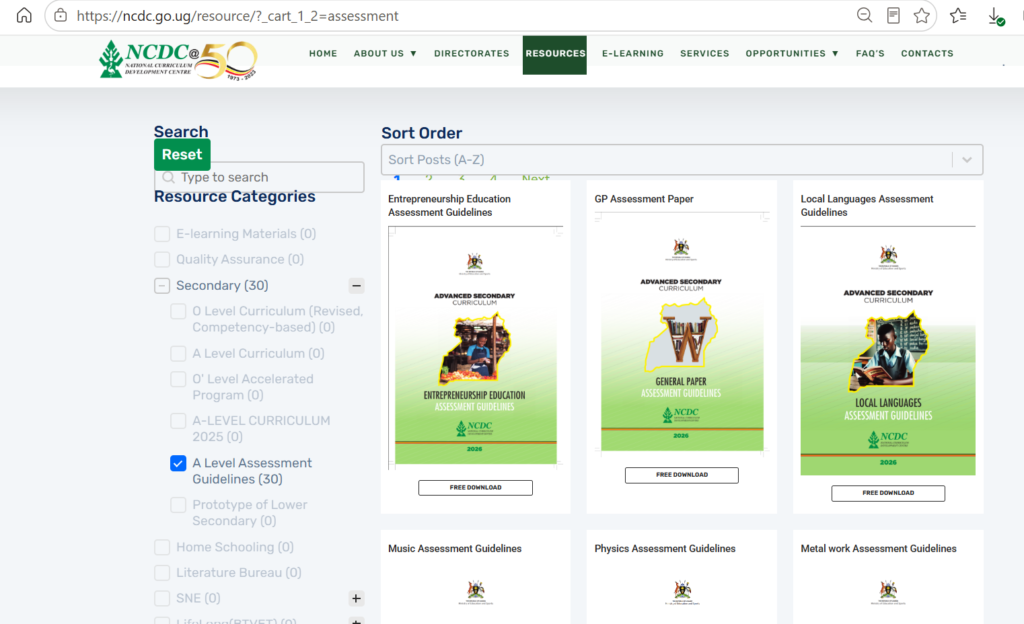
At the time of publication, the NCDC Resources page showed 30 downloads under the “A Level Assessment Guidelines” category. The official framework confirms that subject-specific guidelines have been developed for the 29 subjects on the Advanced Secondary Curriculum menu.
The Assessment Framework for the Advanced Secondary Curriculum is the overarching document that explains how assessment should be planned, administered, scored and reported across all A-Level subjects in Uganda.
The Advanced Secondary Curriculum was revised to align it with the pedagogical approaches, assessment practices and learning expectations introduced under the Lower Secondary Curriculum. It incorporates competencies, values and generic skills, moving assessment away from excessive dependence on content recall towards the practical application of learning.
The framework provides common guidance on:
The guiding principles include validity, reliability, fairness, transparency, inclusiveness, authenticity and the promotion of higher-order thinking through real-world application.
Formative assessment is carried out continuously during teaching and learning. It helps teachers identify learning gaps, provide timely feedback and adjust instruction.
Teachers can collect evidence of learning through:
The framework requires teachers to administer an Activity of Integration (AOI) at the end of each topic. The AOI should present a meaningful scenario that requires learners to integrate knowledge, skills, values and attitudes acquired from the current and previously studied topics.
According to the framework, these topical Activities of Integration replace the beginning-of-term, mid-term and end-of-term tests and examinations that were previously used.
AOI scores can be used to report learners’ progress to parents and other stakeholders. However, the framework states that school-level AOI scores do not contribute to the learner’s final end-of-cycle UACE grade or certification.
The Uganda National Examinations Board (UNEB) will administer the official end-of-cycle assessment after the two years of Advanced Secondary education.
The assessment items will be scenario-based and will require learners to demonstrate their ability to:
An assessment construct is a unifying concept that brings together related topics, competencies and learning outcomes within a subject.
Instead of assessing every topic as an isolated unit, assessment items may require learners to draw knowledge and skills from several related topics under one construct.
The number of constructs in a subject has been used to determine the number and structure of its end-of-cycle assessment papers.
Learners’ responses will be evaluated using analytic scoring rubrics. A rubric divides a task into clear bases of assessment and describes the evidence expected at different achievement levels.
Performance is considered at the construct level using descriptors such as:
The framework provides for final subject grades from A to E, supported by descriptions of what the learner can demonstrate in each construct.
The exact structure varies according to the subject, but the NCDC subject assessment guidelines generally provide the following:
| Section | What it explains | How it helps schools |
|---|---|---|
| Assessment objectives | The broad abilities to be assessed | Guides teaching, assessment and revision |
| Linkage to the syllabus | Relationship between objectives, constructs and syllabus topics | Helps teachers connect assessment with curriculum coverage |
| Table of constructs | Learning outcomes, expected abilities, indicators of mastery and complexity | Supports lesson planning and item development |
| Paper structure | Number of papers, sections, duration and compulsory or optional items | Helps schools prepare learners correctly |
| Sample assessment papers | Contextualised scenarios and tasks reflecting the expected assessment style | Provides models for practice and school-based assessment |
| Scoring rubrics | Bases of assessment and performance indicators for each sample item | Promotes consistent and transparent marking |
| Performance descriptors | Descriptions of learner achievement in each construct | Supports meaningful reporting and feedback |
For example:
The official Advanced Secondary Curriculum Assessment Framework lists the following 29 subjects:
| Subject | Number of constructs | End-of-cycle papers |
| Agriculture | 3 | 2 |
| Arabic | 1 | 2 |
| Art and Design | 2 | 2 |
| Biology | 4 | 2 |
| Chemistry | 4 | 2 |
| Chinese | 1 | 2 |
| Christian Religious Education (CRE) | 5 | 2 |
| Clothing and Textile | 3 | 2 |
| Economics | 4 | 2 |
| Entrepreneurship Education | 3 | 2 |
| Food & Nutrition | 4 | 2 |
| French | 1 | 2 |
| General Paper | 2 | 1 |
| Geography | 4 | 2 |
| German | 1 | 2 |
| History | 4 | 2 |
| Islamic Religious Education (IRE) | 5 | 2 |
| Kiswahili | 2 | 2 |
| Latin | 1 | 2 |
| Literature | 2 | 2 |
| Local Languages | 3 | 2 |
| Metal Work | 2 | 2 |
| Music | 4 | 3 |
| Physics | 4 | 2 |
| Principal Mathematics | 5 | 2 |
| Subsidiary ICT | 4 | 2 |
| Subsidiary Mathematics | 4 | 1 |
| Technical Drawing | 4 | 3 |
| Wood Work | 1 | 2 |
Most subjects have two end-of-cycle assessment papers. General Paper and Subsidiary Mathematics have one paper each, while Music and Technical Drawing have three papers each.
Follow these steps to download the official documents:
Schools should begin by downloading the overall Assessment Framework and then download the guidelines for all the subjects they offer.
Schools can use the documents effectively by taking the following actions:
The sample assessment papers contained in the guidelines are models of the expected assessment approach. They help teachers and learners understand paper structure, scenario development, task requirements and rubric-based scoring.
They should not be treated as leaked UNEB examinations, predicted questions or the only content that learners should revise. Teachers should continue covering the approved syllabus and developing competencies across all the relevant constructs.
The official PDFs are available from the NCDC Resources page. Select Secondary and then A Level Assessment Guidelines.
Yes. The NCDC Resources page provides the documents under a “Free Download” option.
The Assessment Framework identifies 29 Advanced Secondary subjects. The NCDC resource category currently shows 30 downloads, corresponding to the overall framework and subject-level assessment resources.
The framework provides the common principles, approaches, scoring and reporting requirements for all subjects. A subject guideline applies those requirements to a specific subject by presenting its constructs, assessment objectives, paper structure, sample items and rubrics.
A construct is a broad competency area that combines related topics and learning outcomes. It enables assessment tasks to measure whether a learner can integrate and apply learning in a meaningful context.
No. The NCDC framework states that school-level Activity of Integration scores are used for monitoring, reporting and preparing learners, but they do not contribute to end-of-cycle grading and certification.
The Uganda National Examinations Board will administer the official end-of-cycle UACE assessment after learners complete the two-year Advanced Secondary programme.
No. They are sample assessment papers provided to illustrate the expected structure, scenario-based approach, tasks and scoring rubrics.
Every school implementing the aligned Advanced Secondary Curriculum should download and study the Assessment Framework together with the relevant subject assessment guidelines.
Visit the official NCDC Resources page and download the A-Level Assessment Guidelines
Share this article with headteachers, Directors of Studies, Heads of Department, teachers and Senior Five and Senior Six learners so that schools can prepare effectively for competency-based UACE assessment.
Disclaimer: The National Curriculum Development Centre is the official publisher and copyright holder of these documents. Sharebility provides this guide to help schools locate and understand the official resources.

Call: 0776960740 / 0759017164